
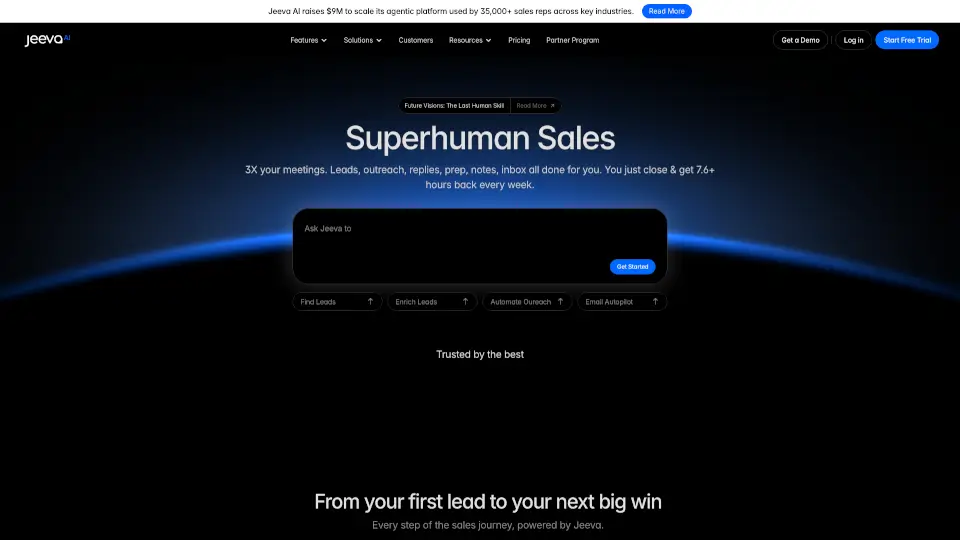
What is Jeeva?
Jeeva AI lets you build, deploy, and govern autonomous digital workers for every team — revenue, IT, service, finance, security, and operations. Instead of static workflows, Jeeva gives you workers that perceive, reason, act, remember, and operate with their own identity. Describe what you want done in natural language, and the platform orchestrates execution across 400+ connectors, a shared memory, and built-in human approvals. Your first worker is running in minutes — no code required.
What are the features of Jeeva?
- Natural‑Language First Deployment: Describe the worker in plain English (“Resolve billing disputes”) and Jeeva auto‑generates the process — no node diagrams or coding.
- Five‑Layer Worker Architecture: Every worker runs on Perception (detect signals), Cognition (plan and self‑heal), Action (400+ API connectors + browser automation), Memory (session history and durable knowledge), and Governance (identity, permissions, full audit trail).
- Shared Worker Runtime: A single runtime powers all your digital workers — they share context, memory, and a planning engine so workers can coordinate across departments.
- Human‑in‑the‑Loop Approvals: Sensitive actions (e.g., expense approvals, high‑value discounts) are routed for human review while routine work stays fully autonomous.
- Continuous Execution: Workers monitor triggers 24/7 — tickets, emails, calendar events, alerts — and complete multi‑step tasks without anyone watching.
- Cross‑System Action: A single worker can pull data from Salesforce, write to Zendesk, send email, update Slack, and trigger a Stripe invoice — all in one session.
What are the use cases of Jeeva?
- Customer Service: Triage, investigate, and resolve tier‑1 and tier‑2 support tickets autonomously, then escalate only when policy thresholds are hit.
- IT Operations: Provision access, handle incident response, and run employee onboarding playbooks — mean resolution under 8 minutes.
- Revenue/GTM: Enrich leads, route opportunities, run personalized outreach sequences, and follow up on stage changes — all from CRM signals.
- Finance & Accounting: Ingest invoices, extract line items, match against POs, and auto‑approve or route exceptions for manual review.
- Security Operations: Detect anomalies, gather context from logs and identity systems, execute first‑response runbooks, and document escalations.
- HR Onboarding: Pull applications from ATS, score against rubrics, schedule interviews, and send outreach or rejections automatically.
How to use Jeeva?
- Describe your worker: Write a sentence like “Resolve billing disputes” — Jeeva’s NLP engine generates the task plan.
- Connect your tools: Authorize Jeeva to access your CRM, support desk, email, calendar, and other business apps.
- Set guardrails: Define which actions need human approval, what data the worker can access, and any business rules (e.g., discount caps).
- Launch and monitor: Deploy the worker — it starts running continuously. Use the dashboard to see live tasks, resolve rates, costs per task, and execution logs.
- Iterate with memory: Workers learn from past sessions. Update their playbooks or retrain them with new examples as your processes evolve.