
What is Consensus?
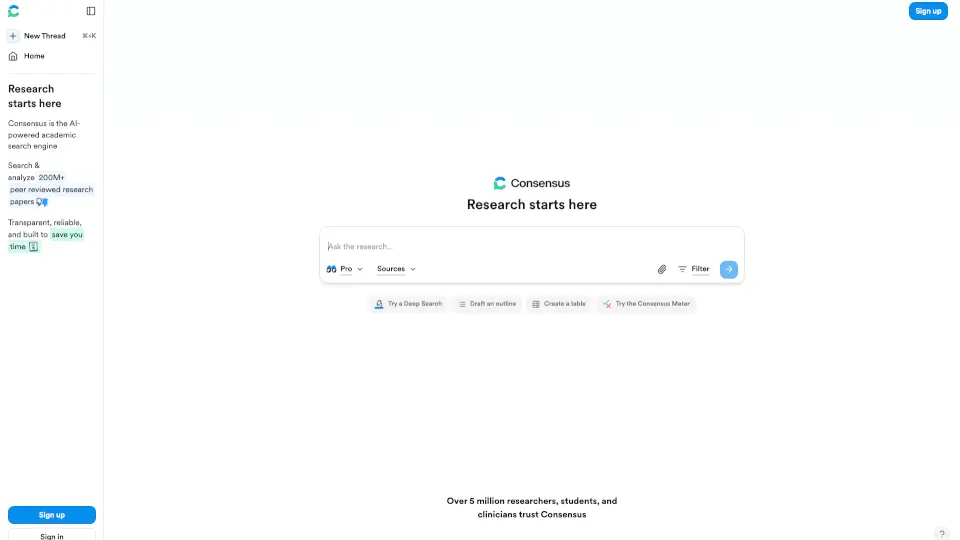
Tired of spending hours digging through academic papers just to find a few useful studies? Consensus: AI for Research is your new go-to academic search engine that helps you find, organize, and analyze peer-reviewed research 10x faster—without cutting corners on quality. Built specifically for students, researchers, and clinicians, it taps into a massive database of 250+ million research papers, including licensed full-text content from top publishers.
Whether you're writing a literature review, exploring clinical guidelines, or trying to understand where experts agree (or disagree) on a topic, Consensus cuts through the noise. It’s already trusted by over 170 university libraries and used daily by 10 million+ researchers, making it the new standard for fast, reliable academic discovery.
What are the features of Consensus?
- AI-Powered Academic Search: Instantly search and analyze over 250 million peer-reviewed papers with smart AI that understands complex research questions.
- Consensus Meter: Ask a clear yes-or-no question (like “Do antidepressants work for mild depression?”) and get a visual snapshot showing how much the evidence agrees or disagrees.
- Deep Search: Automate literature reviews by letting Consensus build a comprehensive search strategy—expanding keywords, mapping citation networks, and surfacing conflicting evidence in minutes.
- Medical Mode: Narrow results to 50,000+ clinical guidelines and 8 million articles from the top 1,000 medical journals for trusted, high-quality clinical answers.
- Natural Language Filters: Use plain English to set filters like “studies after 2020” or “human trials with n > 1,000”—Consensus applies the right technical filters automatically.
- Transparent & Reliable Results: Every claim is backed by real peer-reviewed sources, so you never sacrifice academic rigor for speed.
What are the use cases of Consensus?
- A grad student completes a full literature review in under an hour instead of days using Deep Search.
- A clinician quickly checks current guidelines on acute kidney injury evaluation using Medical Mode.
- A public health researcher explores how consensus has shifted on hormone replacement therapy over time.
- An undergrad compares conflicting evidence on SSRIs and teen suicide risk for a term paper.
- A professor identifies research gaps in long COVID mechanisms by seeing where studies disagree.
- A policy analyst uses natural language prompts to find large-scale studies on intermittent fasting outcomes.
How to use Consensus?
- Start by typing a clear research question (e.g., “Does social media increase depression risk in teens?”) into the search bar.
- Use natural language filters like “only randomized controlled trials” or “studies from 2018–2023” directly in your query.
- Toggle Medical Mode if you need clinical-grade answers from top-tier medical sources.
- Check the Consensus Meter for instant insight into whether the evidence leans yes, no, or mixed.
- Click into results to read AI-generated summaries with direct links to original papers.
- Sign up for free to save searches, organize findings, and access advanced features.