
What is DVC AI?
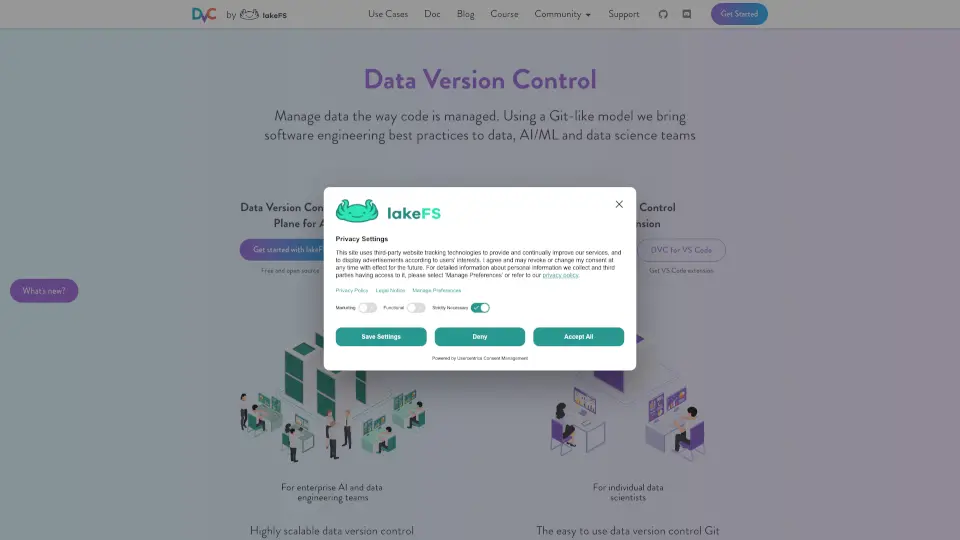
Data Version Control (DVC) is an open-source tool designed for data science and machine learning projects. It offers a Git-like experience to manage data, models, and experiments, making it easier to organize and reproduce workflows. With DVC, you can version large datasets, track experiments, and connect your code to data without the hassle of copying files.
What are the features of DVC AI?
- Data Management at Scale: Handle millions of files in cloud storage efficiently.
- Reproducibility with Git: Use GitOps principles to version data, track experiments, and restore states.
- No Expensive Data Copies: Save metadata instead of moving data, reducing costs.
- Experiment Tracking: Compare results and restore experiment states across teams.
- Integration with DataChain: Build and version datasets without modifying data sources.
What are the use cases of DVC AI?
- Versioning Large Datasets: Keep track of changes in large datasets without duplicating files.
- Experiment Tracking: Log and compare ML experiments for better insights.
- Reproducible Workflows: Create pipelines that connect code, data, and models for consistent results.
- Unstructured Data Management: Organize and enrich datasets with images, audio, video, and text files.
How to use DVC AI?
- Connect Storage to Repo: Link your cloud storage to your repository for seamless data access.
- Configure Steps: Declare dependencies and outputs at each step to build reproducible pipelines.
- Track Experiments: Use Git to log experiments and compare results.
- Get Started: Download DVC via pip, conda, or brew, and explore the VS Code extension for local ML development.