
What is RapidAI?
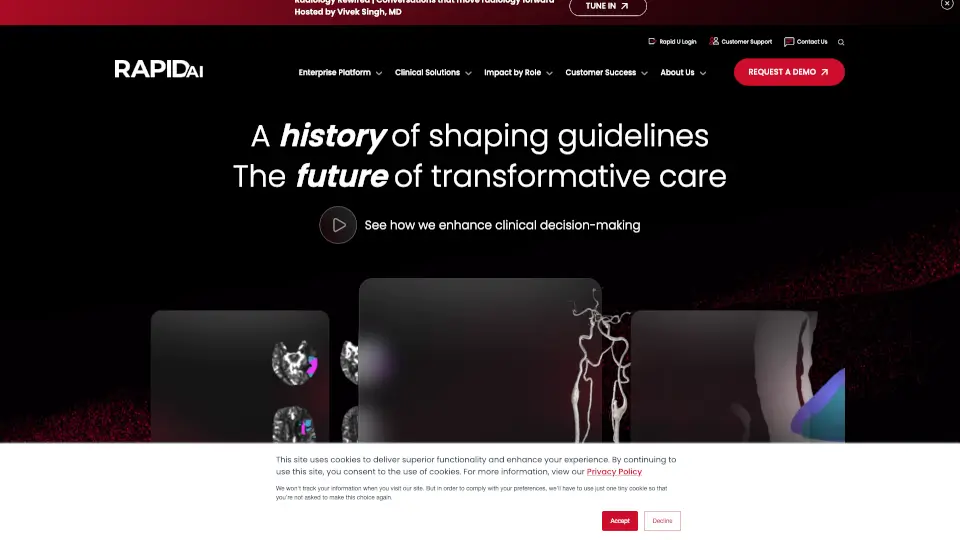
RapidAI is a deep clinical AI enterprise platform designed to help healthcare teams move from imaging to action faster. Instead of just spotting potential problems, it gives doctors deeper insights—like quantifying blood flow, measuring growth, and tracking changes over time. The platform works across your entire health system, connecting imaging tools, electronic health records, and care teams so everyone stays on the same page. Whether it’s stroke, aneurysm, pulmonary embolism, or cardiac cases, RapidAI delivers decision-grade analysis that supports faster, more confident treatment decisions.
What are the features of RapidAI?
- Deep Clinical AI: Goes beyond simple detection to provide quantification, characterization, and longitudinal tracking—so clinicians see not just what is there, but how serious it is and how it’s changing.
- Workflow Integration: Seamlessly connects with your existing EHR, PACS, and workflows to reduce friction and enable real-time clinical action without extra steps.
- Enterprise Infrastructure: Scales securely across a whole health system, with vendor-agnostic integration that fits your current IT stack and meets enterprise-grade security and compliance standards.
- Data + Analytics: Gives administrators visibility into AI performance, utilization, and clinical impact so you can measure outcomes and optimize service lines.
- Rapid Mobile App: Alerts clinicians to urgent cases on their phone, with in-app messaging, DICOM viewer, one-touch procedural workflows, and EMR integration for real-time collaboration.
- Navigator Pro (Radiology): An AI interface for case prioritization, interpretation assistance, autoreporting, and care team connectivity—helping radiologists read faster and easier.
- 30+ FDA-Cleared Modules: Covers neurovascular (stroke, ICH, aneurysm), cardiac & vascular (aortic, PE), and life sciences (imaging biomarker automation, trial analytics).
What are the use cases of RapidAI?
- A stroke team gets an immediate alert on their phones when a CT scan shows signs of a large vessel occlusion—allowing them to prep the cath lab before the patient even arrives.
- A radiologist uses Navigator Pro to prioritize urgent cases flagged by AI, then auto-generates structured reports with quantified measurements, reducing turnaround time.
- A hospital administrator monitors AI utilization dashboards to see which service lines benefit most from the platform and where to focus expansion.
- A cardiologist reviews automated 3D aortic renderings and longitudinal growth tracking to decide on intervention timing for an aneurysm patient.
- A life sciences team uses RapidAI to automatically identify eligible patients for a clinical trial by analyzing imaging biomarkers across the health system.
- A care team collaborates across sites using the mobile app—reviewing AI outputs, source imaging, and patient summaries in real time during a transfer decision.
How to use RapidAI?
- Deploy the platform across your health system with RapidAI’s integration team—connects to your existing EHR, PACS, and workflows with minimal disruption.
- Configure clinical thresholds and notification preferences in the Rapid Mobile App so the right alerts reach the right people based on severity.
- Review AI outputs in the DICOM viewer on desktop or mobile—view automated measurements, 3D renderings, and longitudinal comparisons.
- Act on insights using one-touch workflow initiation (e.g., activate cath lab or stroke team) and in-app messaging to coordinate care.
- Monitor performance via Rapid Insights analytics dashboard to see utilization, clinical impact, and ROI across service lines.
- Train your team through Rapid U, the platform’s immersive professional education program, plus ongoing implementation support from RapidAI partners.