
What is MiroFish?
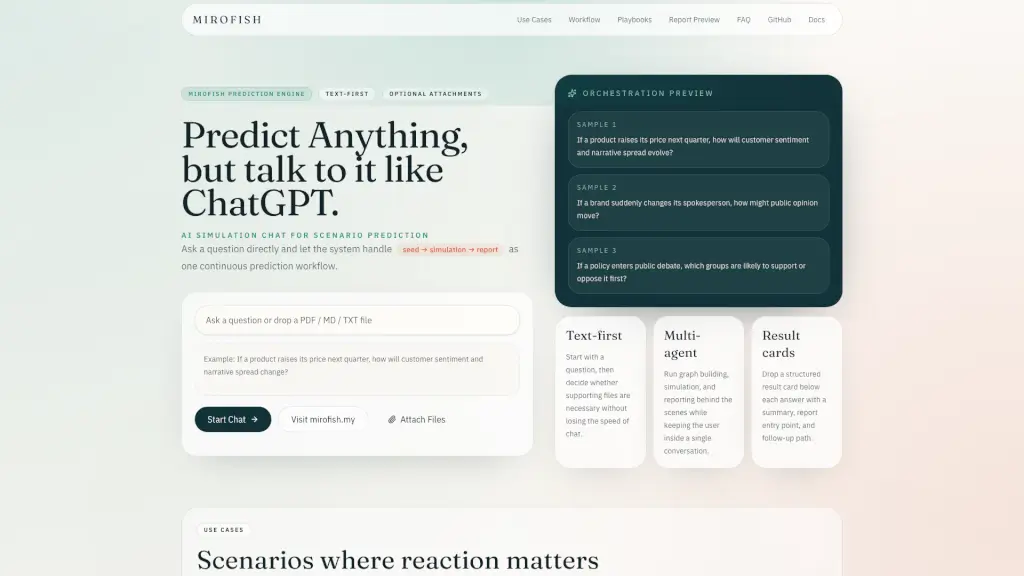
Meet MiroFish—an AI simulation chat that turns your "what if" questions into a full-blown prediction workflow. Think of it like ChatGPT, but instead of a single answer, you get a living world of actors, reactions, and narrative paths. Drop in a plain question or a PDF report, and MiroFish builds a knowledge graph, runs a multi-agent simulation, and spits out a structured report you can keep questioning. It's decision support, not a crystal ball.
What are the features of MiroFish?
- Text-first Chat: Ask a question in natural language, just like talking to a chatbot. No complex setup needed.
- File Attachment Support: Upload PDF, Markdown, TXT, or MD files to ground the simulation in real data, strategy memos, or policy briefs.
- Multi-agent Simulation: The system runs graph building, persona interactions, and social surface dynamics behind the scenes, keeping you in a single conversation.
- Result Cards: Each answer comes with a structured card showing a summary, report entry point, and clear follow-up paths.
- Knowledge Graph Extraction: Automatically extracts actors, relationships, pressures, and anchors from your seed material so agents reason from structure.
- Continuous Interaction: Keep asking questions against the generated world instead of stopping at a static answer.
What are the use cases of MiroFish?
- Test a campaign launch: Pressure-test a new narrative before it goes public. Simulate how different audience groups might amplify or resist your message.
- Explore pricing reaction: Model customer sentiment, value perception, and objection paths across segments before announcing a price change.
- Stress-test a policy: Find the groups, incentives, and second-order reactions in a policy rollout before it enters public debate.
- Watch market narratives: See how narrative, incentives, and sentiment interact when analysts, retail attention, and public discourse create feedback loops.
How to use MiroFish?
- Start with a question: Name the decision, the audience, the trigger, and the time horizon. A narrow question gives the simulated world less room to drift.
- Attach a file (optional): Use PDFs, Markdown, or text files that contain concrete actors, incentives, or prior context. Strategy memos and policy briefs work great.
- Let the simulation run: MiroFish builds a knowledge graph, runs agent interactions, and produces a prediction report automatically.
- Read the report like a rehearsal: Look for resistance signals, narrative bridges, and assumptions worth checking with real data.
- Keep asking: Ask "Which group changes the result if its incentive changes?" or "What if we announce a transition plan?" to dig deeper into the scenario.