
What is Deepnote?
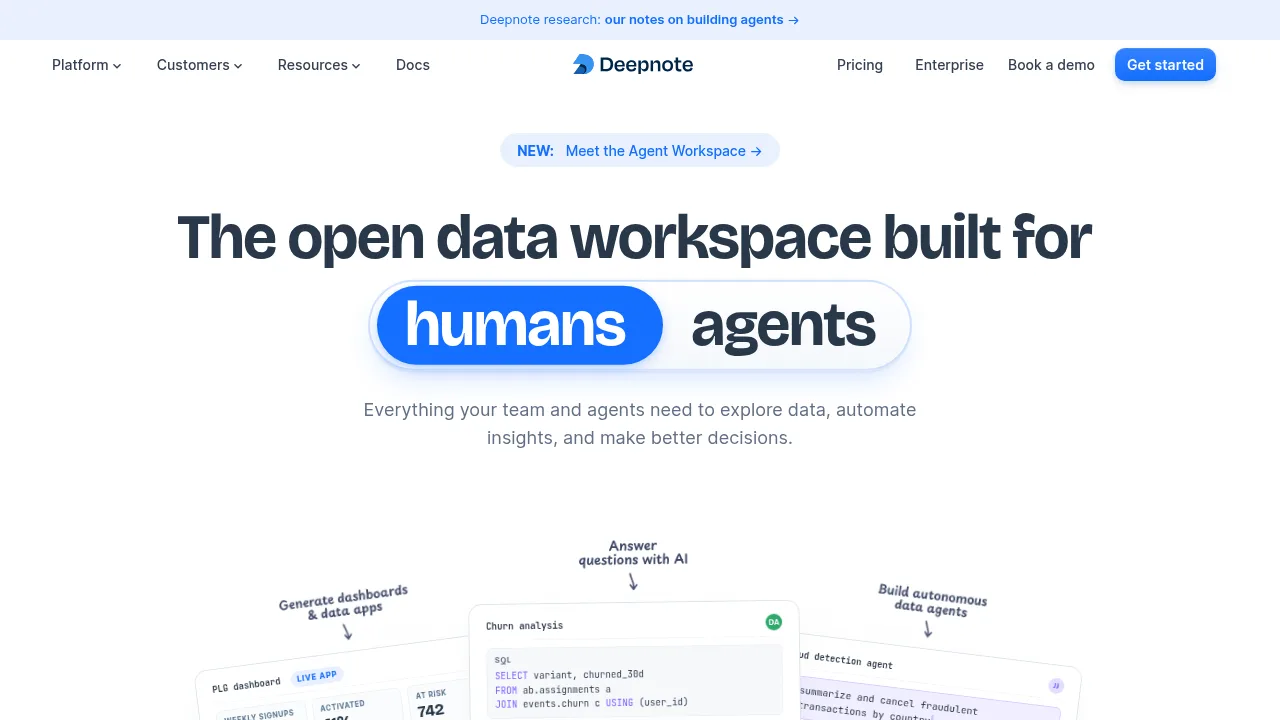
Deepnote is a collaborative data workspace for running Python and SQL notebooks, building dashboards, and deploying data applications. It supports teams and AI agents exploring data through over 100 integrations with warehouses, databases, and lakehouses. The platform runs in the cloud and offers local-to-cloud handoff via Visual Studio Code.
What are the features of Deepnote?
- Collaborative notebooksExecute Python and SQL in shared notebooks with commenting, code reviews, and history versioning.
- Data apps and dashboardsPublish notebooks as interactive reports or hosted applications, hiding code blocks and adding input controls.
- Agent WorkspaceBuild deterministic or non-deterministic data agents that execute multi-step workflows like querying, training, and deploying models.
- Scheduled pipelinesRun notebooks automatically on hourly, daily, weekly, or monthly schedules, or deploy them as APIs.
- Scalable computeChoose hardware ranging from standard CPUs to GPUs, including serverless Spark and Snowpark clusters for terabyte-scale data.
- AI assistance (Deepnote AI)Generate insights, explain data drivers, and build follow-up analysis cells directly within the notebook interface.
What are the use cases of Deepnote?
- A/B test evaluationQuery assignment and event tables with SQL, then use AI to identify churn drivers and segment users by behavior.
- Fraud detection automationConfigure an agent to flag transactions, train a detector model, deploy it via API, and visualize cancellations by country.
- Local-to-cloud developmentWrite analysis locally in Visual Studio Code using the
deepnotepackage, then transfer kernel state, packages, and files to the cloud.
Deepnote Pricing Information:
- Free accessStated as free to get started; specific feature quotas or limits are not detailed in the source.
- EnterpriseCustom deployment options available; requires booking a demo for details.