
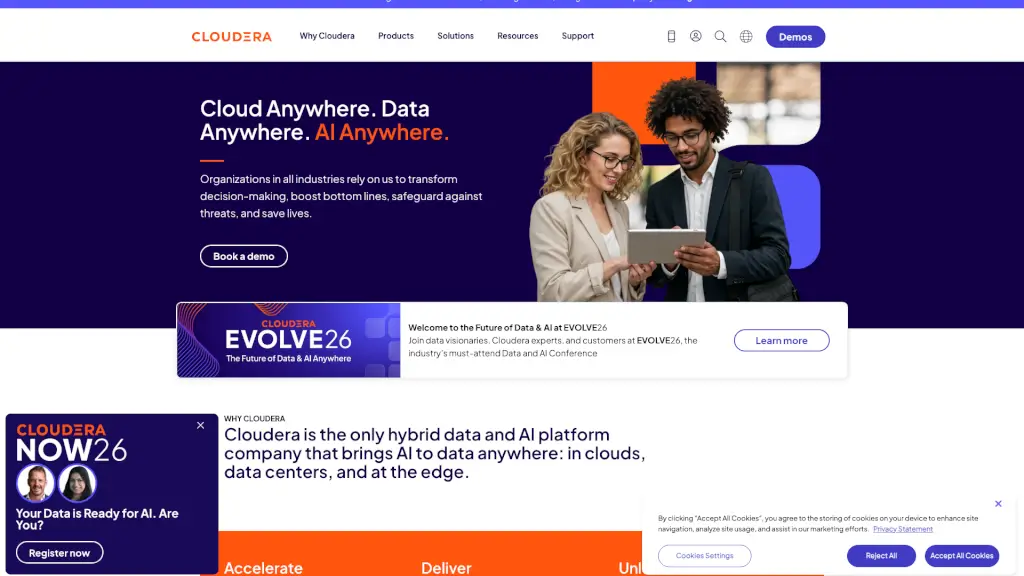
What is Cloudera?
Cloudera is a hybrid data and AI platform that brings artificial intelligence directly to your data—no matter where it lives. Whether your data is in public clouds, private data centers, or at the edge (like IoT devices or remote locations), Cloudera lets you run AI workloads securely and efficiently without moving sensitive information. This approach saves time, reduces costs, and keeps your data governed and compliant.
Designed for enterprises across industries—from banking to healthcare to manufacturing—Cloudera unifies fragmented data systems into a single, open, and intelligent fabric. With built-in tools for data engineering, real-time analytics, and AI development, it empowers teams to turn raw data into actionable insights faster and more responsibly.
What are the features of Cloudera?
- AI Anywhere: Deploy and scale any AI model—like assistants, agents, or inference engines—directly where your data resides, ensuring Private AI with full security and governance.
- Cloud Anywhere: Get a consistent cloud experience across on-premises, multi-cloud, and edge environments without vendor lock-in.
- Open Data Lakehouse: Built on Apache Iceberg, it provides a reliable, unified foundation for analytics and AI using structured and unstructured data.
- Unified Data Fabric: Break down data silos by connecting disparate sources with centralized security, governance, and lineage tracking.
- Data in Motion: Stream and process real-time data from any source to any destination, enabling instant decisions at the edge or in the cloud.
- Enterprise AI Suite: Includes AI Workbench, AI Studios, AI Assistants, and AI Inference Service for end-to-end AI development and deployment.
What are the use cases of Cloudera?
- Detecting financial fraud in real time with machine learning models that analyze transactions as they happen.
- Personalizing customer experiences in retail or banking using AI-driven recommendations based on unified customer data.
- Managing industrial IoT data from remote sensors to predict equipment failures before they occur.
- Accelerating genomic research in life sciences by securely analyzing massive datasets across hybrid environments.
- Enabling sovereign AI in government or regulated industries by keeping sensitive data within approved boundaries.
- Optimizing energy grid performance using streaming data from edge devices and AI-powered forecasting.
How to use Cloudera?
- Start by registering for a demo on Cloudera’s website to explore platform capabilities tailored to your industry.
- Use Cloudera AI Workbench to build and train models using familiar tools like Python, R, or Jupyter notebooks.
- Connect your existing data sources (cloud storage, databases, streaming platforms) to the Open Data Lakehouse for unified access.
- Apply governance and security policies through the Unified Data Fabric to ensure compliance across all environments.
- Deploy trained models using AI Inference Service to serve predictions where your data lives—without copying it.
- Monitor performance and data health with built-in observability and data lineage tools.