
What is Benchling?
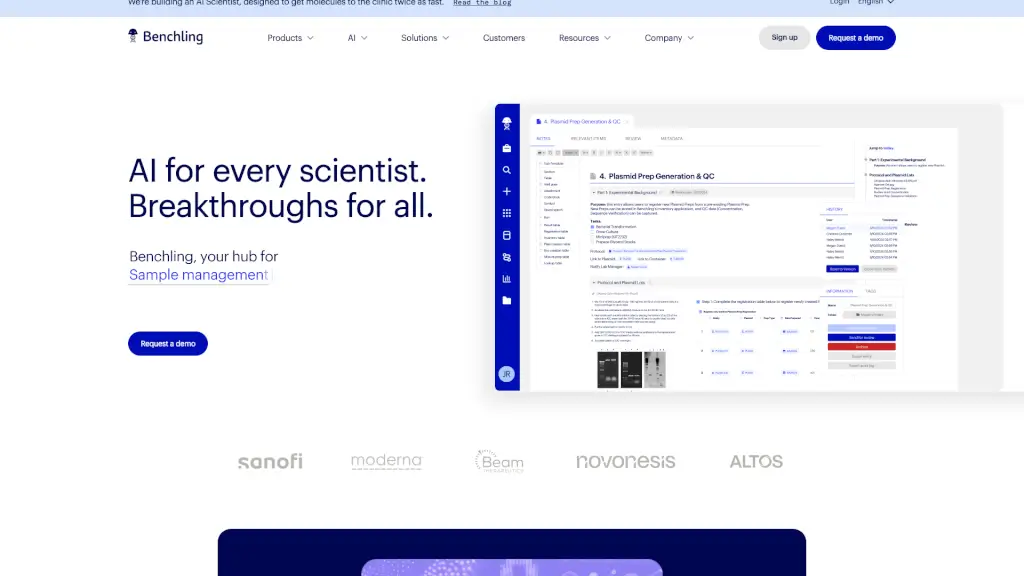
Benchling is a cloud-based platform built specifically for biotech research and development, designed to help scientists work smarter—not harder. Unlike generic lab software, Benchling is biology-first, meaning it understands the unique needs of modern life science workflows, from gene editing to cell therapy. Whether you're in academia, a startup, or a top biopharma company, Benchling brings your experiments, data, and team together in one secure, collaborative space.
At the heart of Benchling’s vision is the AI Scientist—an intelligent system that links predictive models, structured data, and real-world lab work into a continuous loop. It helps design experiments, guides automated or manual execution, captures results cleanly, and suggests the next best step. The result? Faster progress toward getting life-saving molecules into the clinic—potentially twice as fast.
What are the features of Benchling?
- AI Scientist: Automates experiment design, execution guidance, and next-step recommendations using structured data and predictive models.
- Cloud-Based Electronic Lab Notebook (ELN): A collaborative digital notebook purpose-built for complex biology, making it easy to plan, record, and share experiments.
- Unified Data Model: Tracks diverse scientific entities like biomolecules, cell lines, reagents, and animals in a consistent, queryable format.
- Workflow Automation: Reduces repetitive tasks with automated data capture, analysis, and reporting across discovery and development.
- Open Integration Platform: Connects with lab instruments, third-party software, and custom apps via APIs and Benchling’s developer tools.
- Modality-Specific Solutions: Tailored workflows for gene therapy, cell therapy, RNA therapeutics, antibodies, agritech, and more.
What are the use cases of Benchling?
- A gene therapy startup uses Benchling to standardize CRISPR experiment records, track vector designs, and accelerate IND-enabling studies.
- A biopharma team in process development automates data collection from bioreactors and analytics instruments to hit regulatory milestones faster.
- Academic researchers collaborate across labs using shared notebooks and structured data models, reducing time spent searching for past results.
- An in vivo team digitizes animal study protocols, captures real-time observations, and links phenotypic data to molecular findings.
- A cell therapy developer manages complex workflows from donor screening to final product release with full traceability and audit readiness.
How to use Benchling?
- Sign up or request a demo at benchling.com to get started—options are available for academics, startups, and enterprises.
- Set up your team’s workspace by defining your data model (e.g., molecules, cell lines) and inviting collaborators.
- Use the ELN to design experiments with built-in templates for common techniques like PCR, cloning, or NGS.
- Connect instruments or apps via Benchling’s Developer Platform to auto-ingest data and reduce manual entry.
- Leverage AI tools to analyze results, predict outcomes, and generate the next round of experiments based on prior data.
- Explore Benchling Learning Labs to train your team and get certified on best practices for digital R&D.