
What is TensorFlow?
TensorFlow is an open-source machine learning platform that helps developers build and deploy AI-powered applications with ease. Whether you're a beginner or an expert, TensorFlow offers a flexible ecosystem of tools, libraries, and community resources to make machine learning accessible and efficient.
What are the features of TensorFlow?
- TensorFlow Core: A powerful library for building and training machine learning models.
- TensorFlow.js: Run machine learning models directly in the browser using JavaScript.
- TensorFlow Lite: Deploy models on mobile and edge devices like smartphones and IoT devices.
- TensorFlow Extended (TFX): Tools for building end-to-end machine learning pipelines for production.
- Pre-trained Models: Access a wide range of models and datasets for quick deployment.
What are the use cases of TensorFlow?
- Image Recognition: Build models to classify and detect objects in images.
- Natural Language Processing: Create applications that understand and generate human language.
- Recommendation Systems: Develop personalized recommendation engines for users.
- Traffic Forecasting: Use graph neural networks to predict traffic patterns.
- Medical Discovery: Analyze complex data for medical research and diagnostics.
How to use TensorFlow?
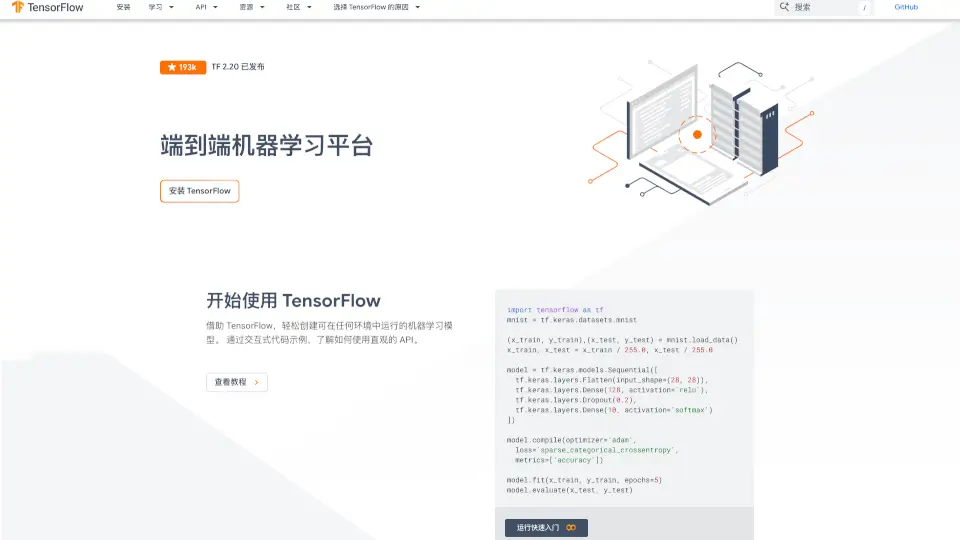
- Install TensorFlow: Start by installing the library using pip or another package manager.
- Load Data: Use built-in datasets like MNIST to train your models.
- Build Models: Create models using TensorFlow's high-level API,
tf.keras. - Train and Evaluate: Compile your model, train it on your data, and evaluate its performance.
- Deploy: Use TensorFlow Lite or TensorFlow.js to deploy your model on various platforms.