
What is PyTorch?
PyTorch is a powerful, open-source deep learning framework that makes it easy for researchers, developers, and students to build and train AI models. Created with flexibility and speed in mind, it’s widely loved for its intuitive design—especially its Python-first approach and dynamic computation graph (called "eager mode") that lets you debug code just like regular Python.
Backed by the PyTorch Foundation under The Linux Foundation, PyTorch isn’t just a tool—it’s a thriving ecosystem. From academic labs to Fortune 500 companies, users rely on PyTorch for everything from computer vision and natural language processing to large language model (LLM) training and real-time inference. With strong cloud support, production-ready deployment tools, and a massive community, it’s built to grow with you—from your first neural network to enterprise-scale AI systems.
What are the features of PyTorch?
- Eager Mode & TorchScript: Write and debug models naturally in Python, then seamlessly switch to optimized graph mode for production using TorchScript.
- Distributed Training: Scale training across hundreds of GPUs with built-in
torch.distributedsupport for research and production workloads. - Robust Ecosystem: Extend functionality with libraries like PyTorch Geometric (for graph AI), Captum (for model interpretability), and vLLM (for fast LLM serving).
- Cloud-Native Support: Run instantly on AWS, Google Cloud, and Azure with pre-configured containers, VMs, and managed services like SageMaker.
- Production Deployment: Use TorchServe to deploy models at scale with monitoring, versioning, and low-latency inference.
- Cross-Platform Compatibility: Install via pip on Linux, macOS, or Windows, with support for CUDA, ROCm, and CPU backends.
- Community-Driven Innovation: Benefit from rapid updates, contributor awards, and global events like the PyTorch Conference.
What are the use cases of PyTorch?
- Training large language models (LLMs) with sequence parallelism using tools like AutoSP
- Building recommendation systems with optimized inference kernels (e.g., In-Kernel Broadcast Optimization)
- Deploying computer vision models for real-time object detection in retail or manufacturing
- Conducting academic research in NLP, robotics, or computational biology with flexible model design
- Serving AI models in production using disaggregated CPU/GPU architectures (e.g., via SMG)
- Creating interpretable AI systems with Captum for healthcare or finance applications
- Scaling deep learning workloads across cloud platforms without vendor lock-in
How to use PyTorch?
- Install PyTorch by selecting your OS, package manager (pip), language (Python), and compute backend (e.g., CUDA 12.6) on pytorch.org, then run the provided command.
- Start with official tutorials like “Learn the Basics” or the “Intro to PyTorch” YouTube series to grasp core concepts.
- Use TorchVision or TorchText for quick access to datasets, pre-trained models, and common transforms.
- For production, convert your model to TorchScript and deploy with TorchServe or cloud ML services.
- Explore the Community Hub and forums to ask questions, share projects, or contribute to open source.
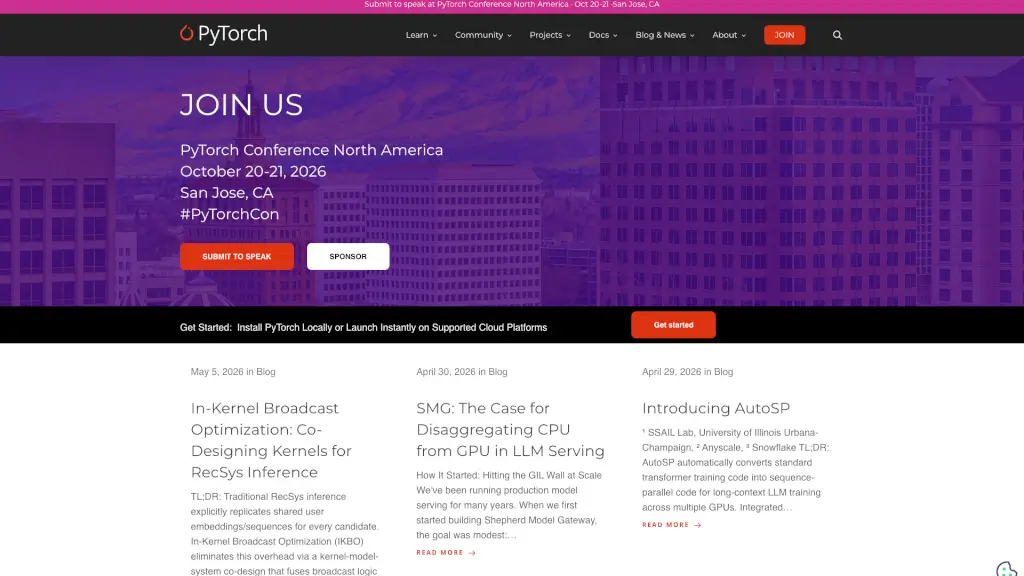
- Attend or submit talks to events like PyTorch Conference North America (Oct 20–21, 2026, in San Jose) to stay updated.