
What is InfluxDB?
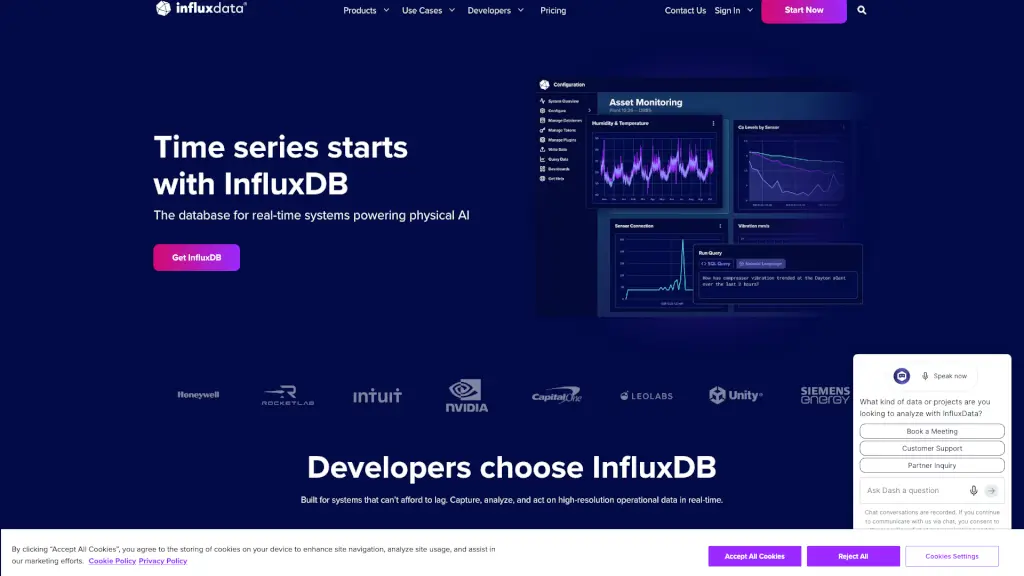
InfluxDB is a time series database built specifically for handling data that changes over time—like sensor readings, system metrics, or real-time telemetry. Unlike traditional databases that struggle with high-frequency, timestamped data, InfluxDB is engineered from the ground up to ingest, store, and analyze millions of data points per second with speed and efficiency.
Whether you're monitoring a global network, predicting equipment failures in a factory, or training AI models on live sensor streams, InfluxDB gives you the tools to capture, query, and act on time-sensitive data without lag or complexity. With both open-source (InfluxDB 3 Core) and enterprise-grade options—including fully managed cloud services—it scales seamlessly from edge devices to massive data lakes.
What are the features of InfluxDB?
- High-Speed Ingest: Handles millions of data points per second without performance drops, even under heavy load.
- Real-Time Analytics: Run SQL-like queries on live data streams to get instant insights and trigger actions.
- Purpose-Built Architecture: Optimized storage with best-in-class compression and automatic downsampling to reduce costs.
- Edge-to-Cloud Continuity: Deploy the same engine on-premises, at the edge, or in the cloud—no pipeline redesign needed.
- Lakehouse Integration: Automatically offload cold data to data lakes (like AWS S3) in Parquet format for long-term AI/ML use.
- Multi-Language Support: Official client libraries for Python, JavaScript, Go, Java, and C# make integration easy.
- Telegraf Ecosystem: Leverage 400+ plugins to collect metrics from virtually any source with minimal setup.
- Open & Extensible: Fully compatible with open standards and integrates smoothly with Grafana, Kafka, Spark, and more.
What are the use cases of InfluxDB?
- Monitoring server and network performance across distributed infrastructure in real time.
- Predictive maintenance in manufacturing by analyzing vibration, temperature, and pressure sensor data.
- Powering physical AI systems that rely on high-resolution telemetry for adaptive control and decision-making.
- Tracking satellite and aerospace telemetry with precision over decades of continuous data.
- Managing grid stability in energy systems using real-time feeds from distributed battery and solar assets.
- Modernizing industrial historians for Industry 4.0 with scalable, cloud-native time series storage.
- Analyzing IoT device behavior across millions of connected products for product improvement.
How to use InfluxDB?
- Set environment variables for your INFLUX_TOKEN and INFLUX_DATABASE to securely manage credentials.
- Use the
InfluxDBClient3library in your preferred language (Python, JS, Go, etc.) to connect to your instance. - Write data using Line Protocol (e.g.,
home,room=Living\ Room temp=22.2,hum=36.4) or structured Point objects. - Query data using standard SQL syntax—InfluxDB 3 supports familiar commands like
SELECT,GROUP BY, andDATE_BIN. - For large-scale deployments, enable automatic eviction to stream older data into your data lake.
- Visualize results instantly by piping query output into Grafana or exporting as Pandas DataFrames or Arrow tables.