
What is Strix?
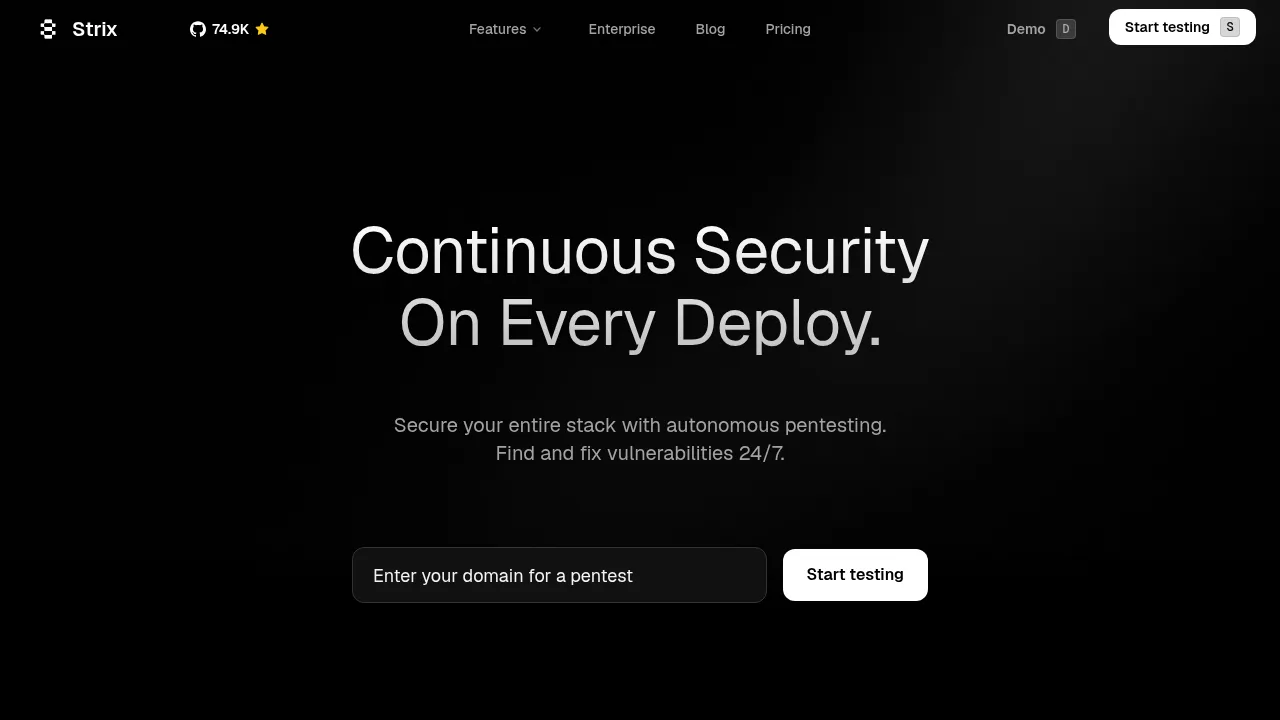
Strix is an autonomous penetration testing platform that continuously scans web applications, APIs, code, and cloud infrastructure for security vulnerabilities. It targets development and security teams by validating findings with proofs of exploit and generating merge-ready pull requests to fix issues. The vendor states that source code is never stored or used for model training, and the platform supports self-hosted deployment in VPCs, on-premise, or air-gapped environments.
What are the features of Strix?
- Continuous penetration testingScans REST APIs, GraphQL endpoints, web applications, and cloud infrastructure continuously, reproducing each finding to confirm exploitability.
- Automated vulnerability remediationGenerates a code fix, retests to verify the vulnerability is resolved, and delivers a merge-ready pull request.
- Pull request security reviewAnalyzes code and pull requests within CI pipelines to catch vulnerabilities before they are merged.
- Proof-of-exploit validationShips every finding with reproduction steps and a proof of concept tested against the live environment.
- Infrastructure and cloud scanningDetects misconfigurations such as public S3 bucket access, IAM wildcard policies, and unencrypted databases across cloud environments.
- Context-aware testingTailors tests based on the target's stack, architecture, and business logic, learning from past findings and applied fixes.
What are the use cases of Strix?
- Preventing vulnerable deploymentsIntegrates into CI/CD pipelines to block merges when new code introduces exploitable security flaws.
- Internal network assessmentTests internal networks, services, and infrastructure from inside an organization's environment, beyond external attack surfaces.
- Remediating specific API flawsIdentifies vulnerabilities like insecure direct object references or server-side request forgery and provides exact code changes to resolve them.
Strix Pricing Information:
- Open SourceFree access to the open-source version of Strix.
- EnterpriseCustom pricing; includes self-hosted deployment options, dedicated support, custom SLAs, priority Slack channel, and SOC 2 Type II and ISO 27001 compliance.