
What is Open WebUI?
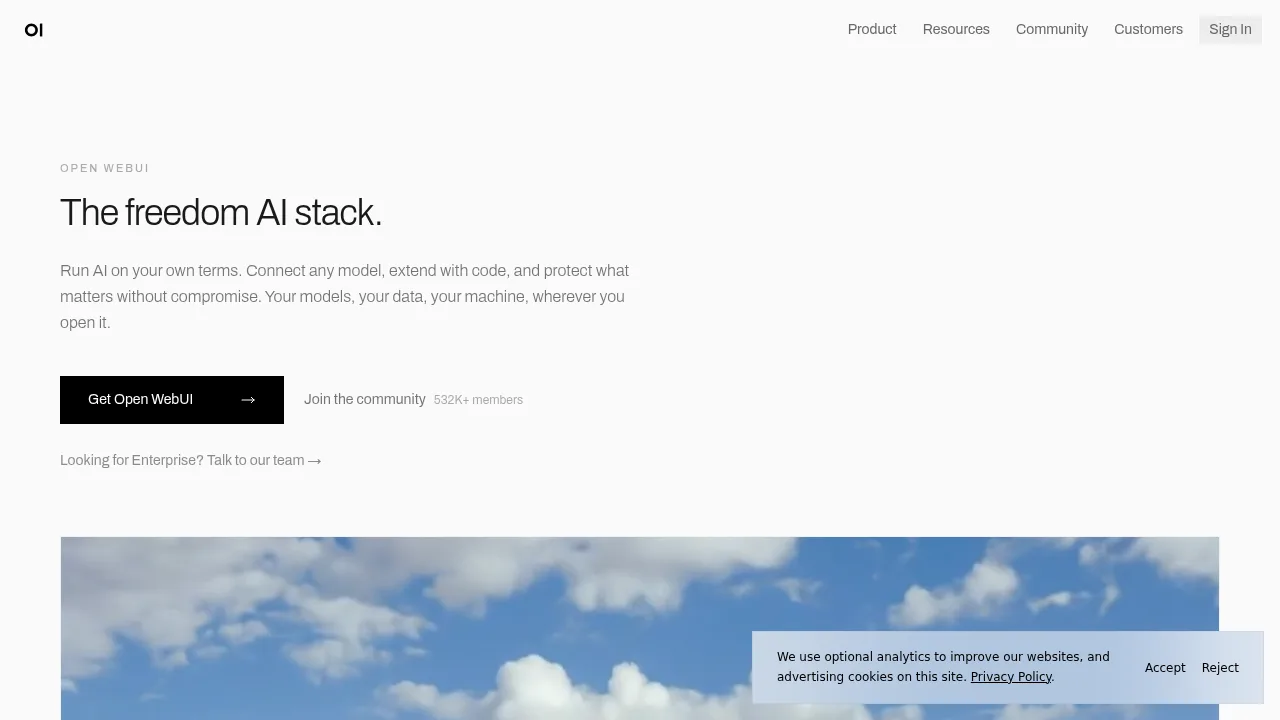
Open WebUI is a self-hosted AI platform that provides a unified interface for running and managing AI models on your own infrastructure. It supports connecting to local or cloud-based models, including Ollama, OpenAI, and Anthropic. The software is installed via pip or Docker without requiring an account, with enterprise options available for organizations.
What are the features of Open WebUI?
- Model connectivityConnects to Ollama, OpenAI, Anthropic, or any compatible model, supporting both local and cloud execution.
- Python extensibilityAllows users to extend platform capabilities using custom Python pipelines (Functions).
- Enterprise access controlsProvides SSO, role-based access control, audit logs, and data residency configurations for regulated environments.
- Community libraryOffers shared prompts, reusable instructions with supporting files (Skills), and tools for retrieval-augmented generation, search, and execution.
- Agent workspace (Open Terminal)Provides a desktop environment, browser, and Git integration alongside chat for AI agents, introduced in v0.13.0.
- Multimodal supportHandles voice, vision, retrieval, generation, and search tasks within the interface.
What are the use cases of Open WebUI?
- Air-gapped deploymentRunning AI models entirely offline on local hardware for environments requiring strict data isolation.
- Regulated industry adoptionUtilizing SSO, RBAC, and audit logs to meet compliance requirements in sectors like healthcare, finance, or government.
- Agent developmentUsing the integrated terminal, browser, and Git tools to build and pass workflows between team members and AI agents.
How to use Open WebUI?
- Install via package managerRun
pip install open-webuior use Docker to deploy the software locally.
Open WebUI Pricing Information:
- Self-hosted installationNo account required; deployed via pip or Docker at no stated cost.
- EnterpriseAvailable by contacting the team; includes features like SSO, RBAC, and audit logs.