

What is marimo?
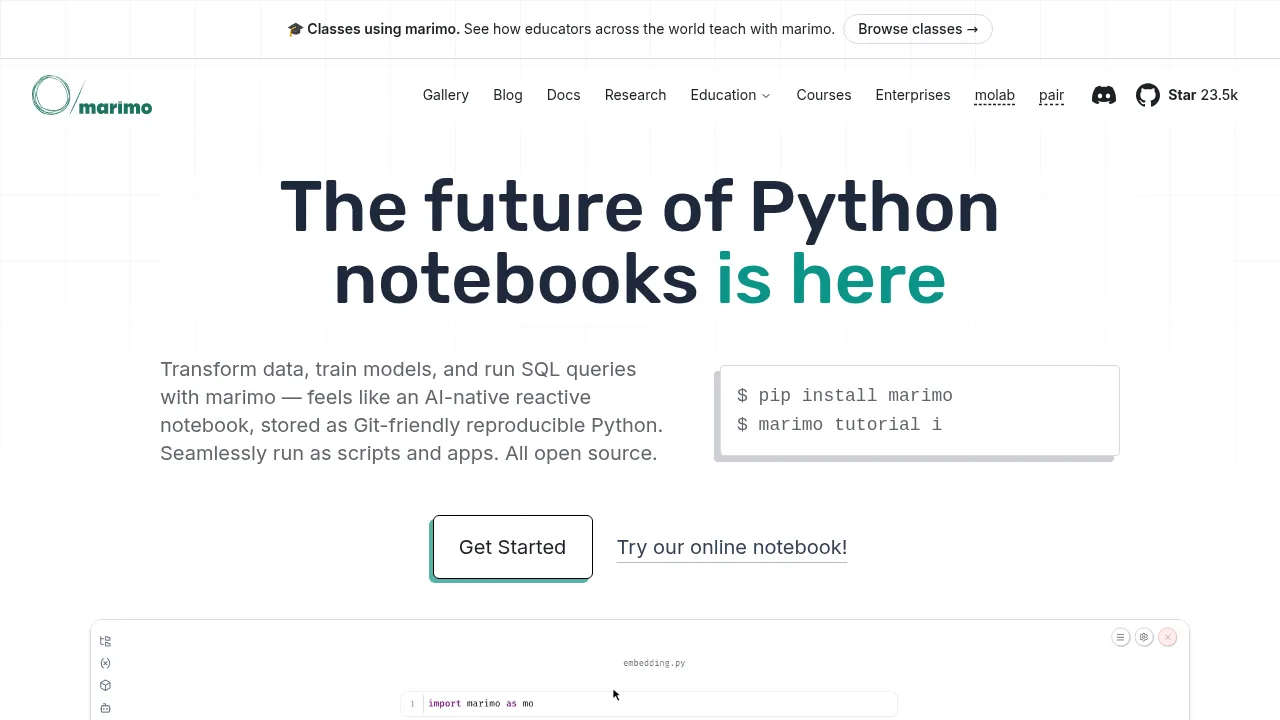
marimo is an open-source reactive Python notebook that transforms data, trains models, and runs SQL queries. Notebooks are stored as pure .py files, allowing them to be versioned with Git, executed as scripts, or shared as web apps. The editor includes built-in AI assistance and can connect external agents to running sessions.
What are the features of marimo?
- Reactive executionChanging code or a value in one cell automatically updates dependent cells, or marks outputs as stale for expensive notebooks instead of autorunning.
- Pure Python storageNotebooks save as
.pyfiles that run as scripts, import as modules, test with PyTest, and manage dependencies via uv and PEP 723 metadata. - Built-in SQL cellsQuery dataframes and databases directly, integrating with Polars, Pandas, PyArrow, DuckDB, SQLite, Postgres, and MySQL.
- Interactive elementsIncludes sliders, dropdowns, dataframe tables, and selectable plots for working with data inside the notebook.
- Web app exportShare notebooks on the web by exporting to WebAssembly-powered HTML or serving them as web apps via the CLI.
- AI agent connectionConnect any AI agent to running notebook sessions using marimo pair, or use built-in copilots, inline edits, and context-aware chat.
What are the use cases of marimo?
- Financial portfolio analysisUse interactive tools to blend single-country ETFs and compare returns against benchmarks like the FTSE All-World.
- Mathematical visualizationExplore ODE solvers with draggable initial conditions or cellular automata using matplotlib.
- Enterprise notebook replacementOrganizations such as DNB Cyber Defense and Sumble have replaced Jupyter or Databricks notebooks with marimo for engineering workflows.
marimo Pricing Information:
- Open sourceThe software is stated to be all open source.