
What is Latenode?
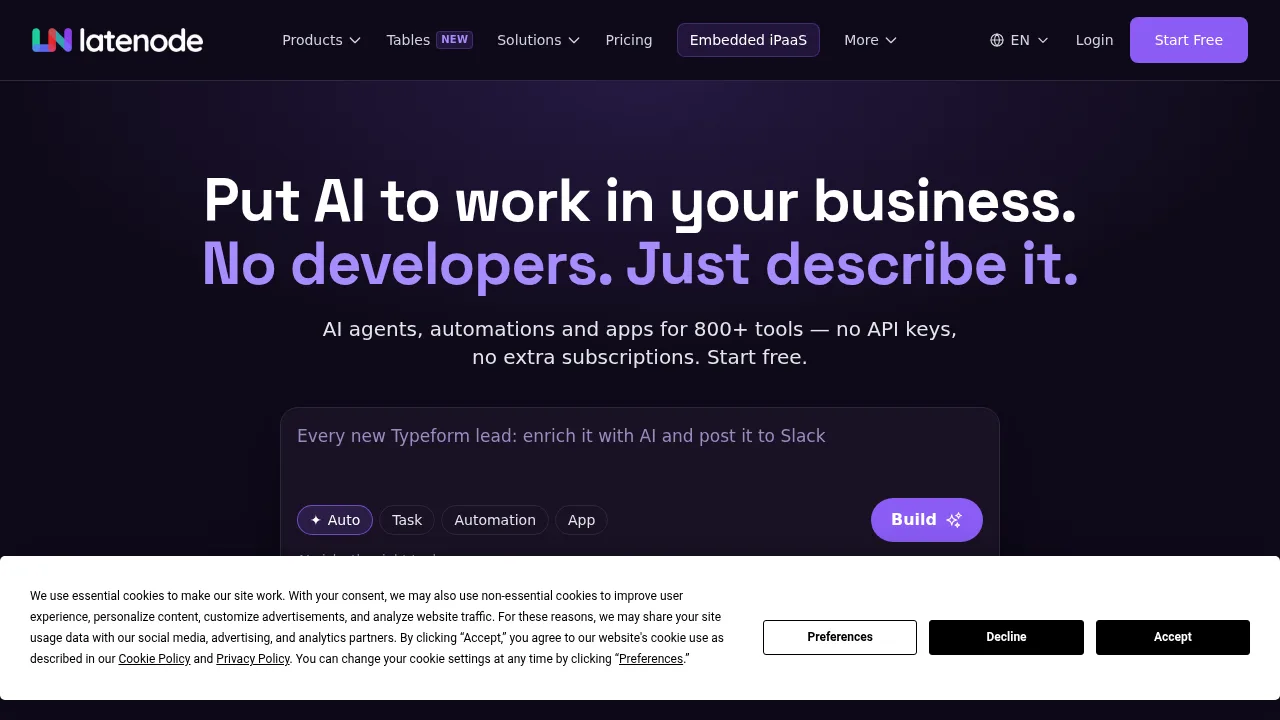
Latenode is a no-code automation platform that builds workflows, AI agents, and apps from natural language prompts. It connects over 800 applications through managed sign-in without requiring users to supply API keys or developer accounts. The service bills usage by CPU execution time rather than per operation.
What are the features of Latenode?
- Chat-based agent (Latenode Agent)Accepts task descriptions in chat, executes them across connected apps using managed sign-in, asks for confirmation before sending, paying, or deleting, and can be scheduled with one click.
- Workflow builder (AI Agent Builder)Generates scenarios containing triggers, AI agents, code, and app connections from a chat description, then runs them in the cloud on each event.
- Application generator (AI App Builder)Produces websites, booking pages, internal tools, and dashboards from chat input, provides live preview during generation, and supports publishing on a free subdomain or custom domain.
- Database tables (Latenode Tables)Operates as a spreadsheet-style database where new rows trigger scenarios, forms write directly into tables, and AI assistants interact via MCP.
- MCP integrationExposes 814 apps and 5,548 actions behind a single MCP endpoint for external agents such as Claude Code, Cursor, and Codex.
- Code nodeAllows JavaScript execution within any workflow node.
What are the use cases of Latenode?
- Phone line automationA voice AI agent called Speaknode answers inbound calls, makes outbound calls, and books or notifies through Latenode integrations.
- SEO data retrievalAn open-source hosted MCP server provides nine read-only tools for Google Search Console.
- Custom development serviceThe vendor's team scopes, builds, and runs automations on the platform for a setup fee starting at $1,000 and monthly retainers starting at $199.
Latenode Pricing Information:
- Free$0 per month; includes 10,000 CPU seconds per month, 5 active workflows, access to all apps and AI models, and requires no credit card.
- Pay as you go$0 base fee; charges per CPU second after the free tier is exceeded, allows unlimited active scenarios, supports setting a monthly spending limit, and uses no per-step billing.