
What is Hidden Door?
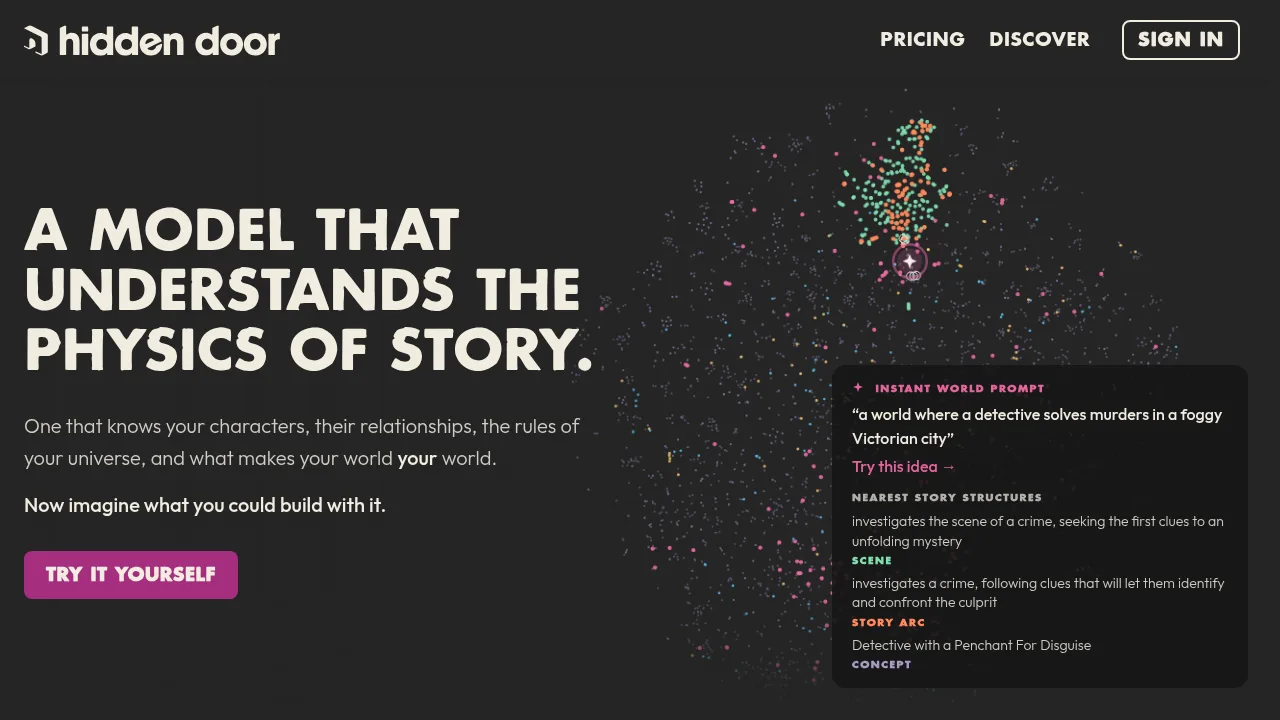
Hidden Door is a narrative world-modeling platform that generates interactive fiction, character chat, and social games from structured story rules. Users can explore official licensed worlds or build custom settings using the Atlas studio. The vendor states that rights holders control canon boundaries for licensed properties.
What are the features of Hidden Door?
- Narrative world modelStores characters, places, lore, and rules in a typed, auditable structure with embeddings for semantic retrieval.
- Story engineConverts player intents into story beats and world-state changes, validating each action against defined canon before display.
- Atlas world-building studioInterface for creators to model, tune, and test custom worlds by defining physics, magic systems, and archetypes.
- Creator MCPAllows builders to create and extend worlds from Claude and other AI assistants.
- Experience APIServes generated content across formats including interactive fiction, character chat, microdramas, comics, and audio series.
- Specialized narrative modelsFine-tuned models handling nearly 100 narrative tasks to plan beats and track state; the vendor claims a tuned 1.7B model outperformed a 120B general model on one core task.
What are the use cases of Hidden Door?
- Licensed IP explorationFans play inside official worlds like Dracula or Pride & Prejudice where every story turn is checked against the rights holder's established canon.
- Custom world creationAuthors and professional creatives define genres, content ratings, and death mechanics to let audiences generate stories within controlled boundaries.
- Multiplayer social playGroups join shared sessions, such as hosting events in a generated world with other players online simultaneously.